MTV Manager
Turn large-scale VM migrations into a manageable workflow
Red Hat Migration Toolkit for Virtualization (MTV) provides the technical foundation for migrating virtual machines to OpenShift Virtualization.
But as the number of virtual machines grows, migration becomes much more than a technical task.
Which systems are ready to migrate? Which are blocked? Who is responsible for each VM? Which migrations are running right now? What still needs to be verified? And most importantly: is the migration project actually moving forward?
MTV Manager adds the operational and project-management layer around Red Hat Migration Toolkit for Virtualization.
It brings inventory, migration readiness, ownership, planning, live migration progress, verification and project history into one workflow.
MTV handles the migration. MTV Manager handles the process.
From inventory to completed migration
A migration project involving a handful of virtual machines can be coordinated manually.
A migration involving hundreds or thousands cannot.
At that scale, the challenge is no longer simply moving virtual machines from one platform to another. Infrastructure, networking, storage, applications, scheduling and people all need to move together.
MTV Manager turns each virtual machine into a managed migration object with its own technical state, ownership, metadata and workflow history.
Instead of working from disconnected spreadsheets, migration plans and OpenShift resources, teams get a common operational view of the entire migration project.
A typical journey may look like:
Discovered → Assessed → Planned → Assigned → Ready → Migrating → Migrated → Verification → Complete
The actual workflow contains additional states for blocked, aborted and exceptional situations, allowing the system to remain explicit when a migration does not follow the happy path.
Know what is ready before the migration window begins
Finding problems during a migration window is expensive.
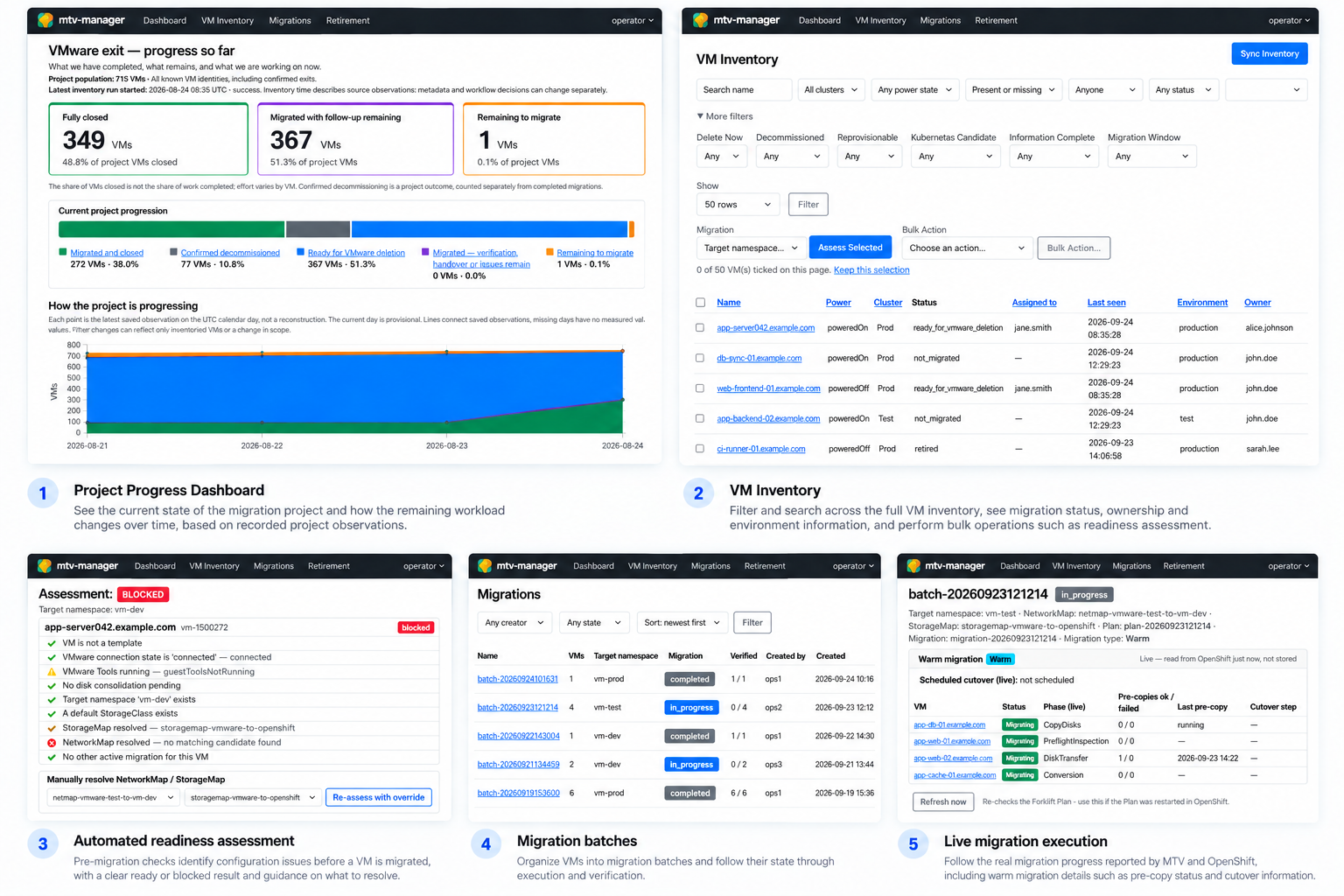
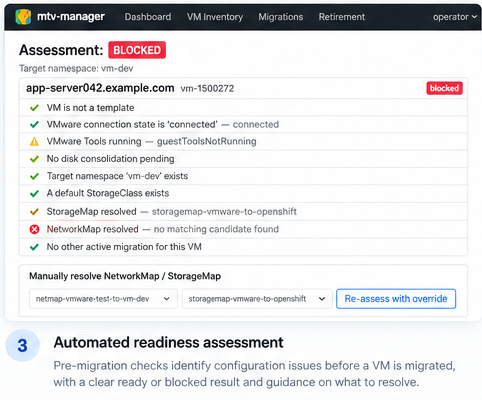
MTV Manager performs automated pre-flight assessment before migration, using real information from the surrounding VMware, OpenShift and MTV environment to determine whether a virtual machine is ready to proceed.
Instead of relying entirely on manual preparation, the assessment produces a clear result:
Ready
or
Blocked
This allows migration engineers to identify problems before the migration starts and concentrate on the systems that actually need attention.
Readiness therefore becomes part of the migration workflow rather than a separate checklist maintained somewhere else.
For a large migration project, this changes an important question from:
“What do we think we can migrate tonight?”
to:
“What has actually passed assessment and is ready to migrate?”
Plan migrations in batches
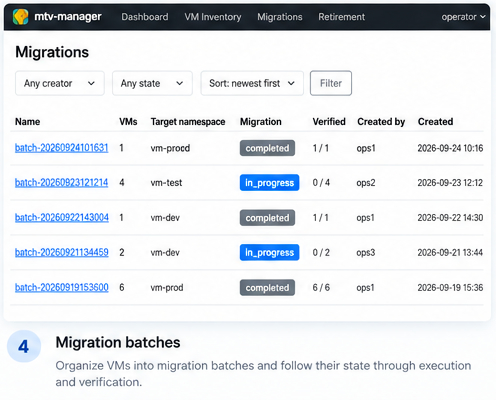
Large migrations are rarely performed one virtual machine at a time.
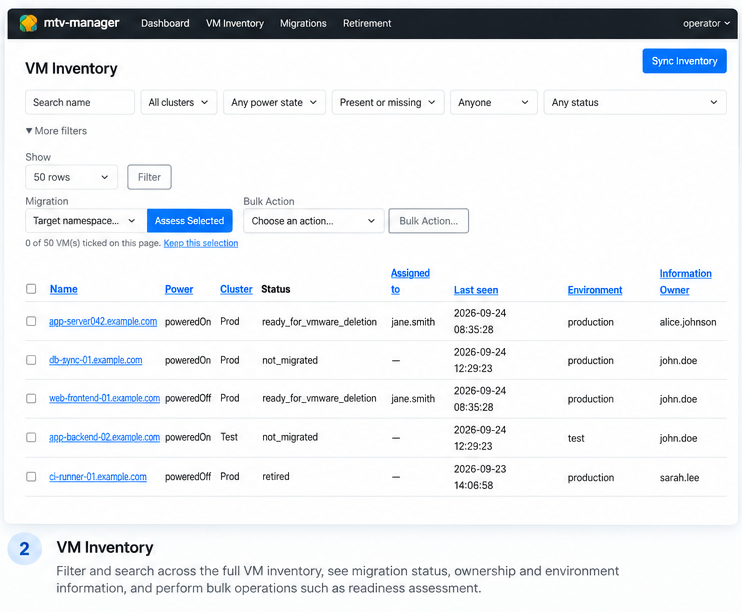
MTV Manager allows operators to filter and select groups of virtual machines and coordinate them as migration batches.
VMs can be selected based on the information relevant to the project, assigned to migration engineers and prepared using the appropriate target environment, network mapping and storage mapping.
MTV Manager then connects that operational workflow with the underlying MTV/Forklift migration plan.
The result is a single workflow from inventory and preparation through to the migration itself.
Bulk selection and actions make the same model practical whether the project contains dozens of virtual machines or hundreds.
Follow real migrations as they happen
MTV Manager does not stop when a migration plan has been created.
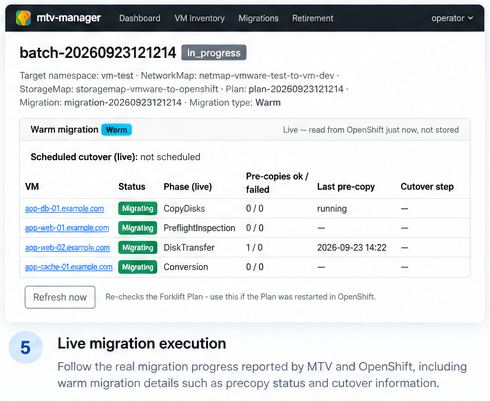
It follows the actual migration state reported by MTV and OpenShift and presents that information alongside the operational information about each VM.
Operators can see which migrations are running, completed, blocked or failed without having to reconstruct the state of the project from multiple Kubernetes resources.
Per-VM migration progress reflects the real phases reported by Forklift, including stages such as initialization, pre-flight inspection, disk transfer, cutover, guest conversion and image conversion.
For warm migrations, MTV Manager can also show precopy health and scheduled cutover information while leaving the actual cutover operation with MTV and the OpenShift tooling responsible for performing it.
The boundary remains deliberate:
MTV performs the migration. MTV Manager tracks and manages the workflow around it.
One view of the entire migration project
Technical migration status is only part of the picture.
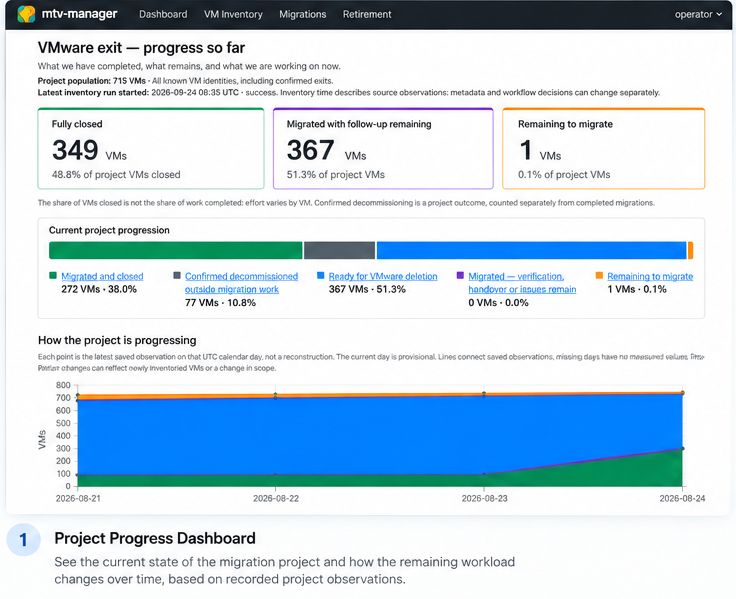
MTV Manager provides a central dashboard that combines migration activity with the overall state of the project.
Teams can see how the VM population is distributed across the migration workflow, what work remains, where systems are blocked and how much of the project has been completed.
The same data can then be explored at VM level using filtering, search and bulk selection.
This gives different parts of the project the view they need.
Migration engineers can focus on systems requiring technical action.
Project teams can focus on progress, remaining work and blockers.
System owners can be represented directly in the workflow through ownership and verification responsibilities.
Everyone works from the same underlying migration state.
See whether the project is actually moving
A snapshot tells you where a migration project is today.
It does not tell you whether the project is progressing.
MTV Manager records project observations over time, creating a durable historical view of migration progress rather than trying to reconstruct yesterday’s state from today’s data.
The Project Progress view combines the current state of the project with historical trends showing how the remaining workload develops over time.
This makes it possible to answer questions such as:
How much work remains?
How quickly is the backlog shrinking?
Has progress accelerated or stalled?
Are systems moving through the workflow or accumulating in a particular state?
Historical observations turn the dashboard from a current-status display into a way of following the migration project itself.
Every VM has context
A virtual machine is more than its migration status.
MTV Manager keeps the operational information surrounding each VM together with its technical state.
That can include migration ownership, customer-specific metadata, migration batch, readiness information, migration progress and verification state.
Custom metadata allows information specific to an organization or migration project to become part of the same working model without turning every requirement into a hardcoded product field.
CSV-based metadata import provides a controlled preview-and-apply workflow for bringing external project data into MTV Manager.
This makes it possible to combine information from different parts of the organization while keeping MTV and OpenShift authoritative for the technical migration state.
Verification is part of the migration
A technically completed migration is not necessarily a completed migration project.
The application or service still needs to be verified in its new environment.
MTV Manager treats verification as a first-class part of the workflow.
Verification can be recorded against the migrated VM, making the distinction between:
“MTV finished migrating it”
and
“the organization has verified that the system works.”
That distinction becomes particularly important when hundreds of systems are being migrated and responsibility for technical migration and application verification belongs to different people.
The migration is not lost from the workflow simply because the data transfer completed successfully.
Built for large migration projects
MTV Manager is designed around the operational problems that appear when migration stops being an individual technical activity and becomes a project.
Filtering, bulk selection and bulk actions allow operators to work with large VM populations without processing every system individually.
Ownership makes responsibility visible.
Automated assessment separates migration-ready systems from blocked systems.
Live MTV integration shows what is actually happening.
Verification keeps migrated systems in the workflow until the work is genuinely complete.
And Project Progress provides a view across the entire migration effort.
Together, these capabilities help answer the questions that repeatedly arise during a large migration:
What can we migrate next?
What is blocking the next migration batch?
Who owns this system?
What is migrating right now?
Which systems still need verification?
What failed during the last migration window?
How much work do we actually have left?
Extensible by design
No two migration projects have exactly the same requirements.
MTV Manager therefore separates a reusable product core from the organization-specific information and policies surrounding a migration.
The core provides the migration workflow, MTV/OpenShift integration, inventory, assessment, project tracking, ownership, metadata and verification model.
Customer deployments can then adapt the product where the migration project requires additional information or organization-specific behaviour.
The application includes extension points for customer metadata, selected workflow policies and import transformation without requiring customer-specific assumptions to become part of the generic product.
This allows MTV Manager to remain reusable while still being adapted to the environment in which it is deployed.
A common product core. A migration workflow adapted to the organization using it.
Built for production
MTV Manager is designed to run alongside OpenShift and MTV as part of a real migration environment.
Production deployments use PostgreSQL for persistent application data and provide role-based access control, audit history and OpenShift health and readiness integration.
Five built-in access levels separate different operational responsibilities, while protected actions are enforced throughout the application.
Deployment and release tooling is designed around the same principle as the application itself: preserve state, detect problems early and fail safely rather than silently continuing when the environment is not in the expected state.
The result is not a demonstration dashboard built around sample migration data.
It is an operational tool designed around real MTV migration projects.
Possible extensions for your organization
The following are examples of customer-specific extensions and are not included in the standard product by default.
The architecture of MTV Manager makes it possible to build additional integrations and workflows when a migration project requires them.
Depending on the organization, this could include integration with enterprise identity providers such as Microsoft Entra ID, CMDB or asset-management systems, notification and approval workflows, Microsoft Teams integration, organization-specific reporting or additional project dashboards.
For example, an identity and notification integration could allow an application owner to be notified automatically when a VM has completed migration and needs verification.
A CMDB integration could enrich the migration inventory with organizational ownership or application relationships.
A customer-specific reporting layer could expose the information required by a migration programme without changing how MTV itself performs migrations.
These are examples of how a deployment can evolve around a customer’s requirements — not functionality that MTV Manager claims to provide out of the box today.
A reusable core, adapted to your migration
MTV Manager is not intended to replace Red Hat Migration Toolkit for Virtualization.
It makes MTV easier to operate as part of a large migration project.
MTV remains responsible for moving virtual machines.
MTV Manager provides the structure around that work: inventory, readiness, ownership, planning, progress, verification and project history.
That distinction is what allows the two systems to work together.
MTV performs the migration.
MTV Manager manages the journey.
Planning a large OpenShift Virtualization migration?
MTV Manager can be deployed and adapted to the requirements of a specific migration project while keeping the reusable product core separate from customer-specific functionality.
If you are planning a migration involving a large number of virtual machines and need more than individual MTV migration plans to coordinate the work, get in touch with cname.se to discuss how MTV Manager could fit into the project.